
|
When
should my child have their first visit?
Our office,
as well as the American Academy of Pediatric
Dentistry, recommends that your child visit
the dentist by his/her 1st birthday. The
first visit on these young children are
often a “look” visit to get them used to the
dentist and sometimes a quick cleaning and
fluoride treatment. Our hopes are to bring
them in when they are very young and get
them used to what happens in the dental
office, as well as help to answer your
questions about diet and hygiene.
How
can I help my child have a positive dental
experience?
Here are a
few suggestions to prepare your youngster
for the initial visit. First, tell your
child that the doctors want to get to know
him/her; present this visit as an exciting
experience for yourself and for your child.
Second, tell your child that we will
“count,” “brush,” and “take pictures” of
his/her teeth. By explaining the exam and
the cleaning in these terms, your child will
better understand the situation. Most
importantly, be incredibly positive about
this experience. Avoid negative words such
as “hurt,” “drill,” “pull,” and “shot.”
Also, do not use statements such as “the
doctor will hurt you.”
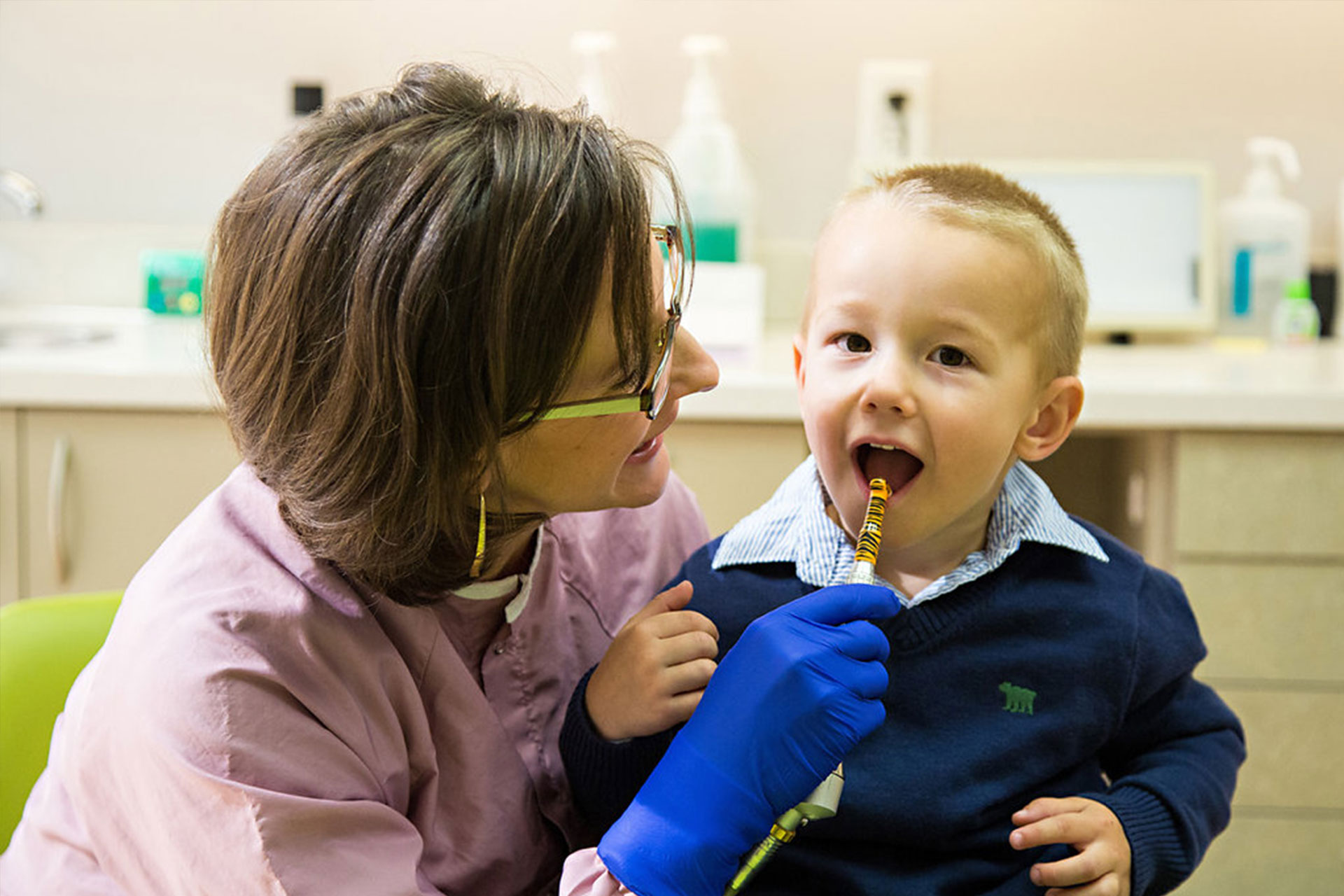
Our initial
examination involves nothing uncomfortable
and should be perceived by the child as
non-threatening. It is our goal to make this
first visit the most positive experience
possible. A comprehensive exam, cleaning,
fluoride treatment and x-rays are the
ultimate goal, however, sometimes less is
accomplished in order to maintain a happy
first visit with our younger patients.
First Visit Movie
This is an example of how we examine a very
young patient
Many children this age are not
cooperative, our goal is to get them used to
having us in their mouths. Of note, parents
can use this positioning at home to deliver
homecare too. Hover your mouse over the
video to
pause or
rewind.
Can
I stay with my child during their visits?
Yes! You are
welcome to stay with your child throughout
all dental procedures. We realize that all
children mature at different rates and we
encourage parents to take an active role in
their child’s dental home care.

|